Computer Science undergraduate working across ML systems, computer vision, and backend engineering. I build the infrastructure that makes an experiment reproducible and a model's output reviewable — evaluation protocols, detector benchmarks, local inference services, and human-review workflows.
01 ICML 2026 workshop paper · co-author02 4 model families · 5-run workflow03 NoteFlow v0.1.0 · 19 backend tests04 10 public project repos · status tracked
01 / ENGINEERING WORK
Evidence before claims.
01ML systems · Reproducible evaluation
VISDRONE / CONTROLLED PROTOCOL
01
02
03
R50SWINVMAMBART-DETR
5 RUNS
CPU validated · GPU runs pending
Aerial Object Detection Benchmark
A single-protocol VisDrone comparison across four detector families, built so the comparison stays fair when data splits, search budgets, and hardware differ.
What I built
Implemented four detector adapters behind one interface: Faster R-CNN with ResNet-50, Swin-T, and VMamba-T backbones, plus RT-DETRv2-L.
Built the VisDrone-to-COCO conversion, annotation validation, class-collapse tracks, and dataset manifests that every model consumes.
Evidence
Four model adapters and the complete five-run operator path are CPU-validated in CI. The repository states its limits: no GPU READY record, measured runtime, or benchmark result exists yet.
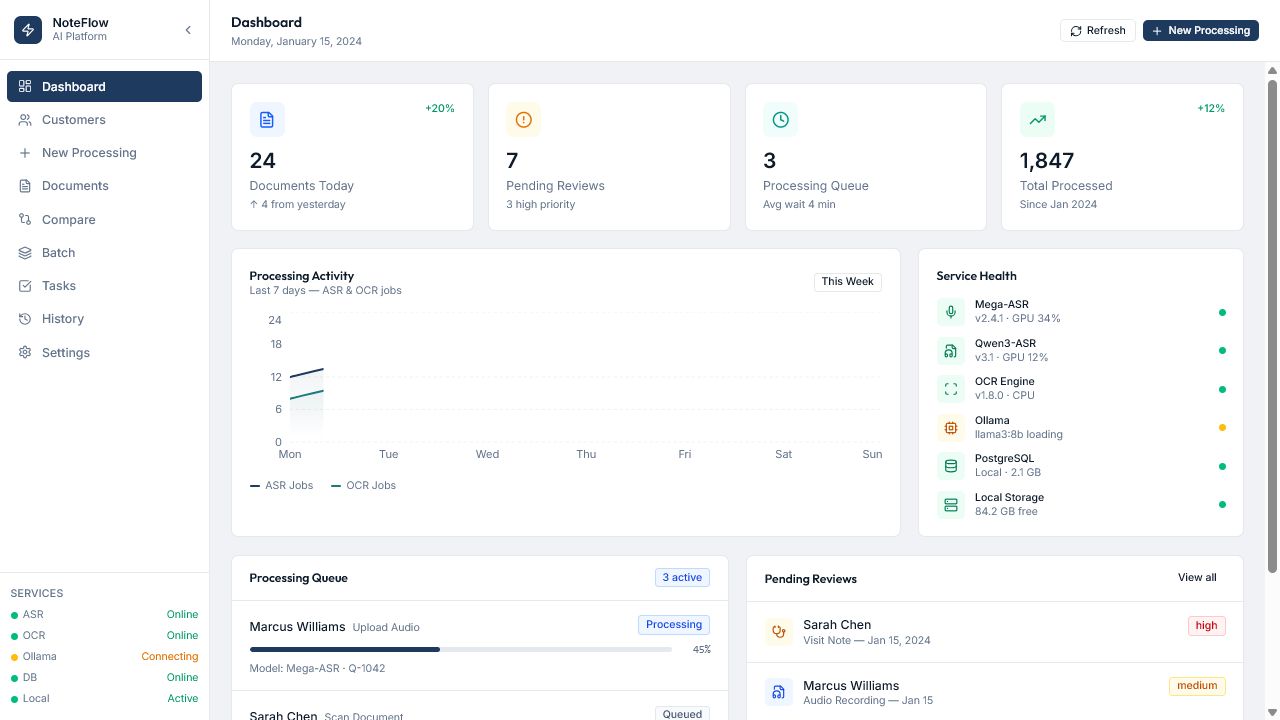
A documentation workflow that turns notes, recordings, and scans into reviewable records, keeping source, model output, and human correction separate.
What I built
Built the FastAPI backend as the system of record: SQLAlchemy entities, Alembic migrations, and ownership checks across documents, tasks, audits, and exports.
Implemented correctable ASR and OCR records that retain both the original and the edited value rather than overwriting model output.
Evidence
Tagged release v0.1.0 (July 2026) with 19 backend tests, plus frontend lint, type checking, tests, and production build enforced in CI. All demo data is synthetic; not for clinical use.
Corpus foundation implemented · Downstream scaffolded
Vietnamese Legal AI
A four-repository system for screening draft clauses against Vietnamese law. The corpus foundation now produces deterministic, evidence-backed snapshots; retrieval, conflict analysis, and reviewer reporting remain gated behind corpus review.
What I built
Defined immutable Pydantic and JSON Schema contracts for source artifacts, legal documents, versions, provisions, relation edges, and corpus manifests.
Implemented stable hierarchy and version IDs, content-addressed source ingestion, and deterministic text, HTML, DOCX, and text-PDF parsing with an explicit OCR boundary.
Evidence
VietLegalCorpus main passes 76 automated tests plus Ruff, strict mypy, deterministic snapshot checks, and real corpus evaluation. Official-source legal review is still pending, so G1 is not claimed as passed; retrieval and conflict detection are not yet implemented.
The featured cards prioritize depth. The status ledger below tracks every public project repository, including coursework, scaffolds, and this portfolio.
02 / PROJECT STATUS
Every repository, clearly labeled.
Statuses are based on the default branch, releases, and open work visible on GitHub. “Scaffold” means the repository's domain pipeline is not implemented yet. A foundation label names completed infrastructure without implying that a downstream benchmark or delivery gate has passed.
Layer-Wise Perturbation Profiles for Diagnosing Vision Robustness
Son Nguyen · V. G. Bao · Quang M. Phan · Trong P. Le
Aggregate robustness scores show whether a model fails, not where its internal representations become fragile. The paper profiles corruption effects layer by layer and uses that signal to choose where to adapt a model.
My contribution: ran the controlled ResNet-50 and ConvNeXt-Tiny experiments on CIFAR-10 and CIFAR-10-C.
Compared full fine-tuning, LoRA, and profile-selected layer subsets.
Analyzed clean and corrupted accuracy, parameter counts, and multi-seed variance.
Top-k LoRA used about 696× fewer trainable parameters while retaining most corrupted accuracy. Figures as reported in the manuscript; the lab's experiment code is not redistributed here.
04 / EXPERIENCE
Engineering across models and products.
SOFTWARE ENGINEERING INTERNSHIPMAY 2026 — PRESENTHO CHI MINH CITY, VIETNAM
Software Engineering Intern
FPT Software
Built a FastAPI and React workspace around reusable local speech inference.
Designed single-file and batch transcription APIs that keep one model resident across requests.
Implemented inference locking, input validation, and explicit decode and memory error handling.
Integrated recording, upload, preview, and service-status flows.
Employer code and checkpoints are private and not published.
UNDERGRADUATE RESEARCH · VOLUNTEERMAY 2026 — PRESENTMINNEAPOLIS, MINNESOTA
Undergraduate Research Volunteer
Ding Lab · University of Minnesota Twin Cities
Prepared datasets for a PhD-led AI hardware and systems research project.
Reviewed preprocessing output and flagged inconsistent or low-quality samples.
Ran controlled computer-vision experiments and analyzed model behavior.
Supported reproducible workflows through structured review and execution.